

publicClientId and a domain to the Logo Link URL and use it as your <img> source URL.
Logo Link is designed for direct image embedding. Do not download, persist, or rehost the image files. Normal browser/CDN caching directed by the response headers is allowed.
Integrate Context.dev's Logo Link in your app
Try it
Prerequisites
1
Sign up
Create an account at context.dev/signup. The free tier includes 10,000 one-time Logo Link credits, no credit card required.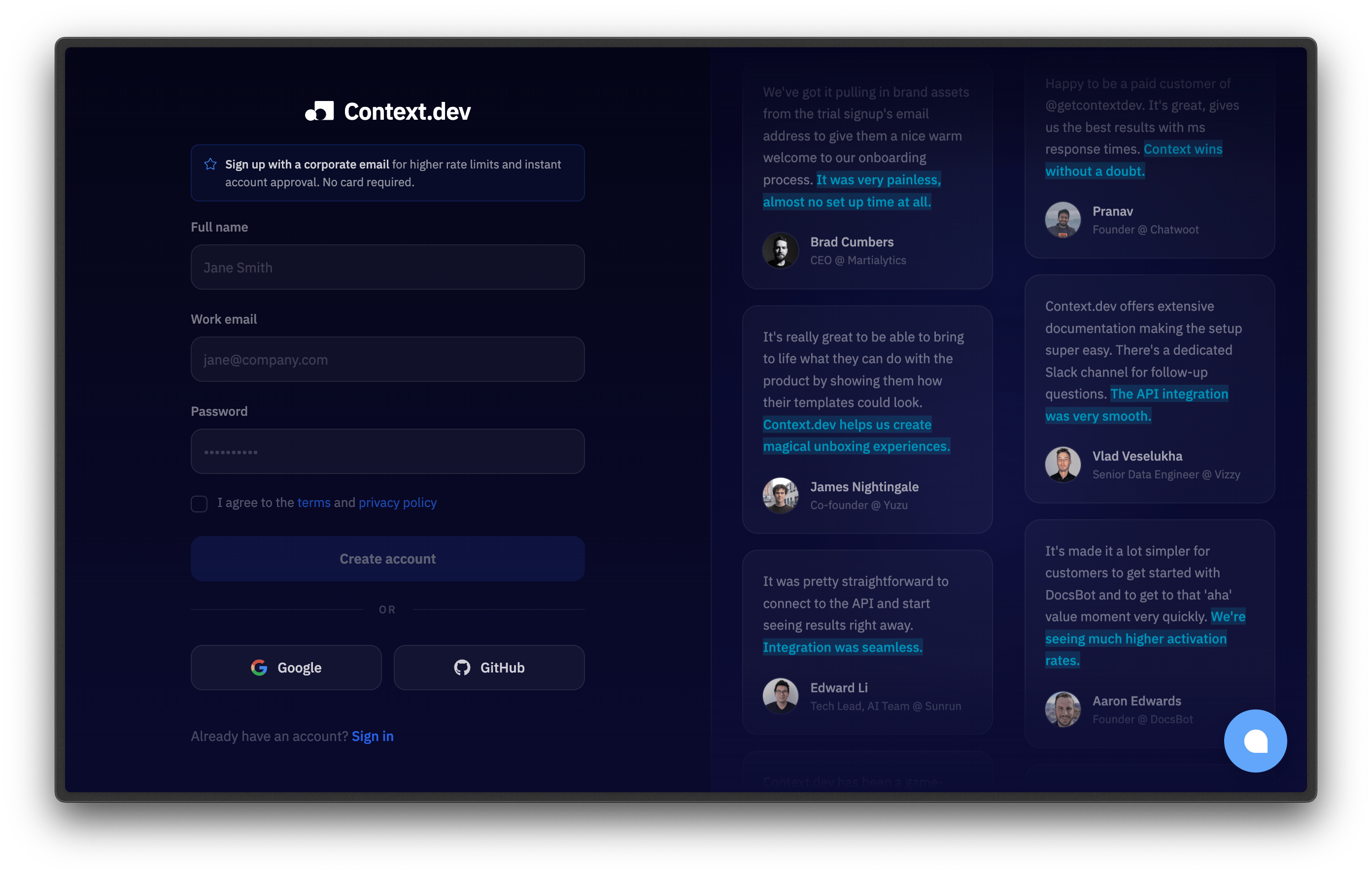
2
Get your Public Client ID
Go to the Logo Link dashboard and copy the key from the “Public Client ID” section.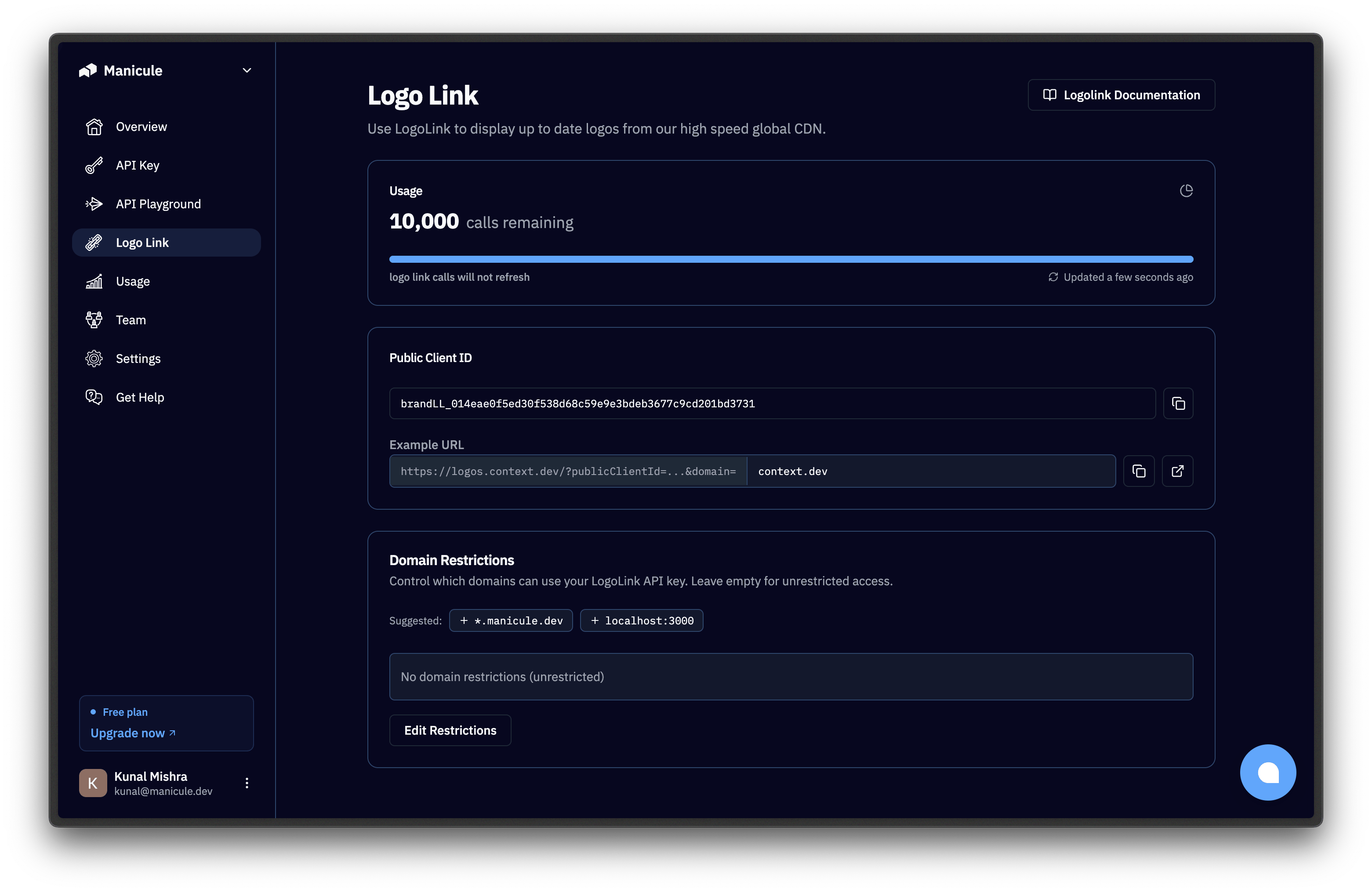
This
publicClientId is safe to expose in your frontend, because it can only be called by the domains you have explicitly allowed.3
Important: Set Domain Restrictions
Click on Edit Restrictions and add your website domain where the image will be embedded: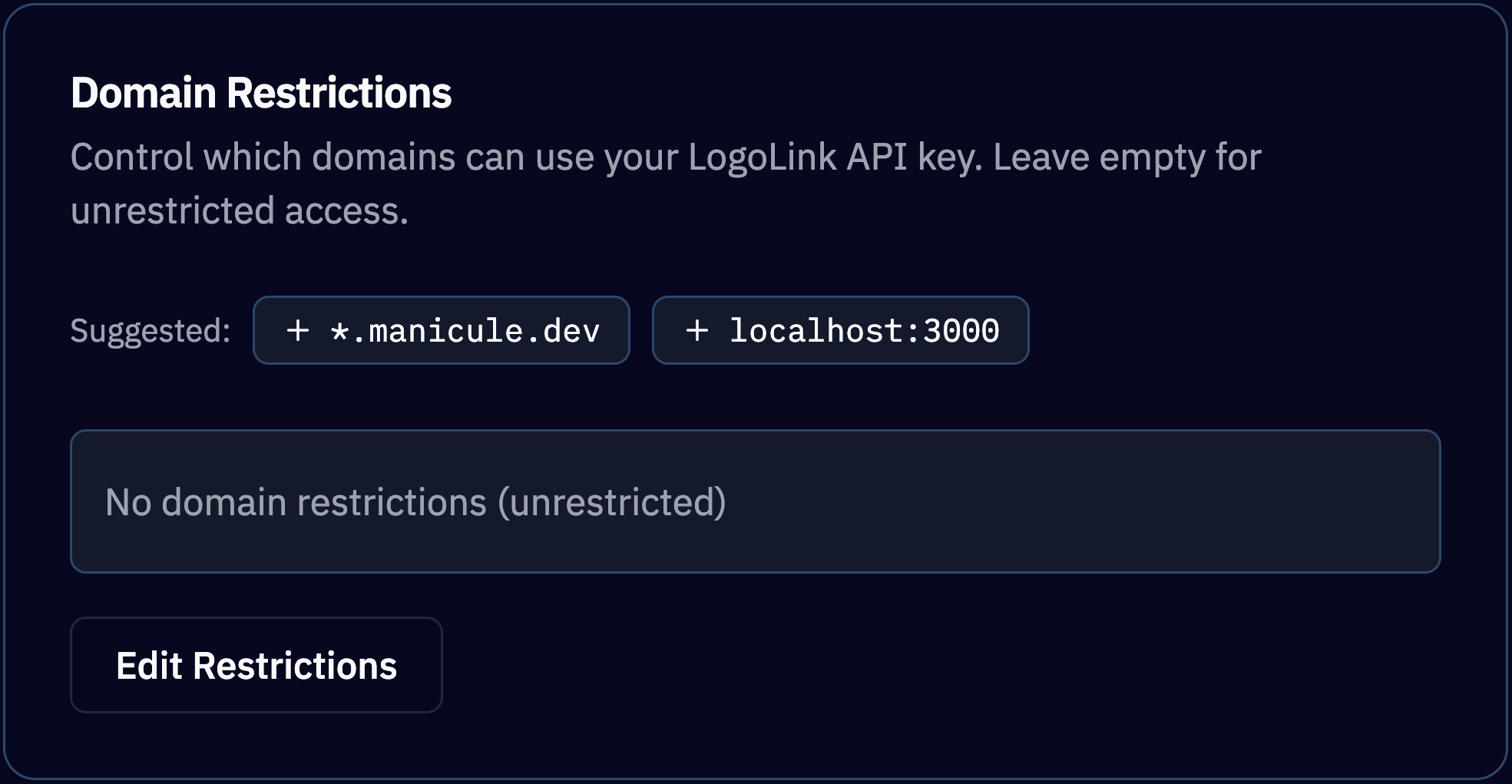
*.example.comlocalhost:3000
Build the URL
ReplacepublicClientId and domain in the Base URL and set it as the image source. You can also add a theme parameter to request the best logo for a light or dark themed application, and a type parameter to choose a square icon or a wordmark at least 1.5:1:
Parameters
Logo Link accepts only
GET and HEAD requests.Response
The body is the raw logo bytes; there is no JSON envelope. Point an<img> tag at the URL and the browser renders it. Fetch it with code and you get a binary blob.
Pricing
Logo Link usage is billed separately from the core Context.dev APIs. Logo Link requests do not consume API credits or the core API RPM budget. Paid plans include a recurring Logo Link pool; Free includes a one-time grant:
See pricing for details.
Logo Link image delivery is separate from core API rate limits. Track the applicable Logo Link quota and current usage in the Logo Link dashboard; current service-level throttling or fair-use rules are governed by the Logo Link service terms. Browser/CDN caching directed by its response headers is expected and allowed. See Usage Restrictions for what is not.
Embed the image
Drop the URL into any place that accepts an image source:<img>, CSS background-image, an email template, a spreadsheet =IMAGE() cell.
- HTML
- CSS background
- React
- JavaScript fetch
- Email HTML
- Sheets / Excel
Handle image-load errors in your UI with an initials, icon, or hidden-image fallback. Do not assume every unknown or unavailable domain will return a usable image.
Usage Restrictions
Logo Link is intentionally ephemeral, fast and image-only. You are not allowed to download and re-host logos retrieved from Logo Link, or persist the image files in your own storage. (Normal browser and CDN caching driven by the response’sCache-Control headers is fine.)
Use Context.dev’s Brand APIs if you:
- Need to store brand-response metadata or media URLs under the Brand API terms
- Get multiple logo variants (light / dark / opaque background, icon vs wordmark)
- Or, pull logo colors and other brand details alongside the logo
Use cases
Logo Link is purpose-built for client-facing embeds where you’d otherwise have to host logo assets yourself:- CRM & Sales Platforms: Drop a Logo Link URL into every contact record.
- Customer Logo Walls: Use users’ sign-up email domains to automatically generate “trusted by” strips on landing pages.
- Financial & Banking Apps: Render merchant logos next to transaction descriptors.
- Directories & Marketplaces: Populate listings with logos automatically, with no upload step in vendor onboarding.
Next steps
Full Brand Profile
Logos, colors, socials, address, and industry from one call.
Google Sheets Recipe
=IMAGE() formula patterns for logo columns at scale.Best Practices
Caching, error handling, and key hygiene.
Troubleshooting
Status codes, retry patterns, and common errors.